THE READING ROOM
外婆菜谱里的“一碗”,是哪只碗?
同样是“一碗面粉”,周平却做出足够吃两顿的疙瘩汤。一次祖孙同厨,让旧方子多了蓝边碗的分量,也留下了那碟葱花的来历。
Which Bowl Did Grandma Mean?
本篇原创感悟
一家人把同一道菜再做一遍,纸上就能多留下几个原本只有手才记得的细节。
Original reflection
When a family cooks a dish together again, the page can hold a few more of the details that only their hands remembered.
一个人吃了两顿 / Enough for two meals
周平第一次照着外婆写的方子做番茄疙瘩汤,从星期一晚上吃到了星期二中午。方子只有半张纸,第一行写着“一碗面粉”。他从橱柜里拿了只白汤碗,装满,照着拌。两个番茄煮出的红汤起初还看得见锅底,面疙瘩一下去,铲子就能在里面划出一条迟迟合不拢的沟。
The first time Zhou Ping made his grandmother’s tomato soup with little bits of dough, he ate it for Monday supper and again for Tuesday lunch. Her recipe took up half a sheet of paper. The first line called for a bowl of flour. He filled a white soup bowl from his cupboard and mixed the dough. At first he could see the bottom of the pot through the broth from two tomatoes. Once the dough went in, his spatula left a furrow that took its time closing.
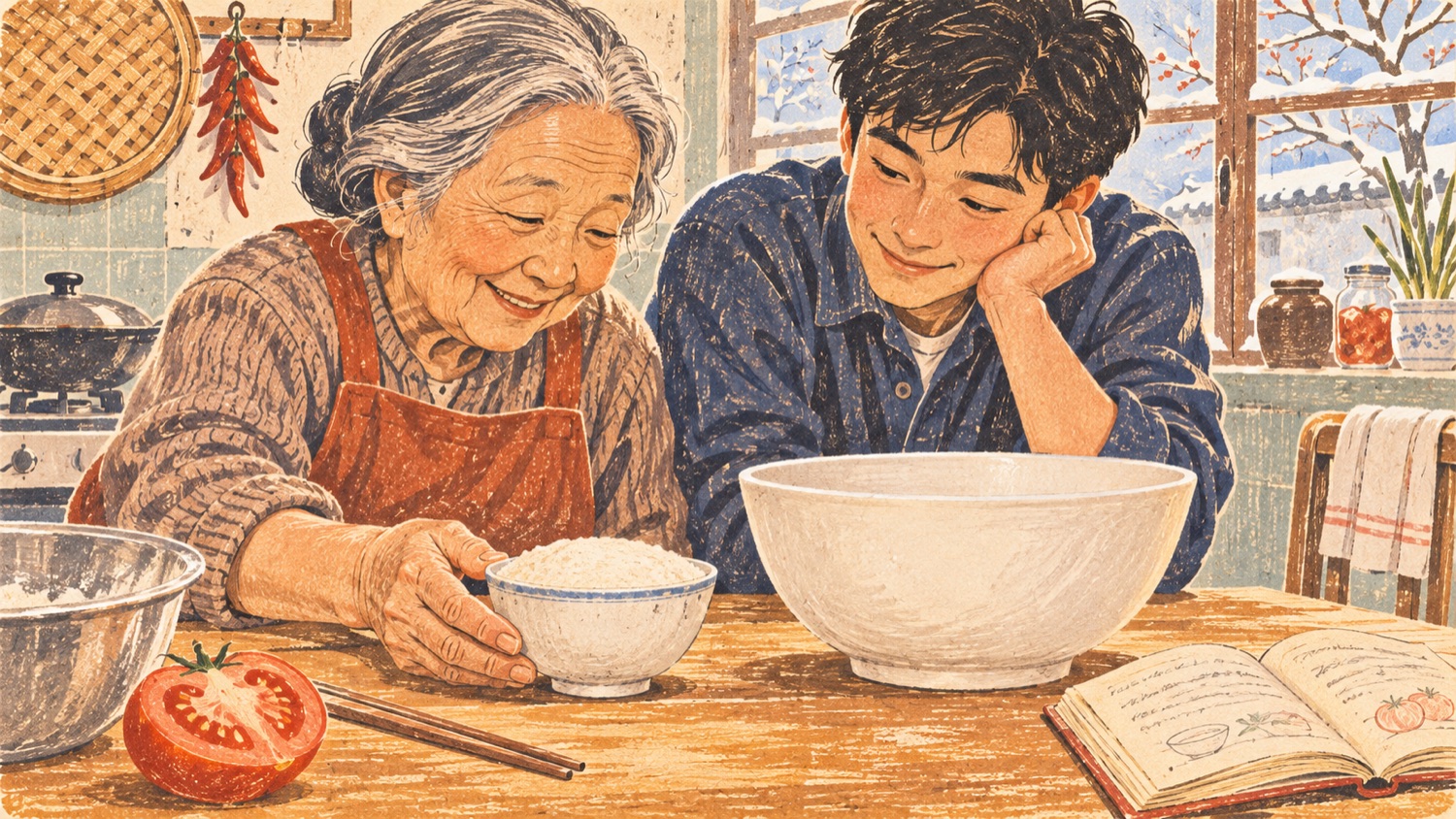
星期六回去,他把这件事当笑话讲。外婆听了半天,先问他用的什么碗。他从柜子里找出一只跟家里差不多大的碗摆上桌。外婆瞪圆了眼,又从摞得高高的盘子旁边摸出一只蓝边小饭碗。两只碗并排放着,答案一眼就能看明白。他小时候天天端着吃饭的那只碗,原来也是家里用得最久的一件量具。
When he visited on Saturday, he told the story for a laugh. Grandma listened, then asked which bowl he had used. He found one in her cupboard about the size of his own and set it on the table. Her eyes widened. From beside a tall stack of plates she produced a little blue-rimmed rice bowl. Side by side, the two bowls told the story. The bowl he had eaten from every day as a child had also been measuring flour for years.
那天午饭前,他们决定再做一回。周平把方子铺在远离水槽的一角,旁边放一支铅笔。外婆照常做,他只负责拌面,碰到自己在家里做得不一样的地方就停一停。刚舀完面粉,他已经添上了第一行小字,“蓝边饭碗,装到碗口”。在“碗口”旁,他还画了两道歪歪的蓝边。
Before lunch they decided to make it again. Zhou Ping spread the recipe on a corner of the counter away from the sink, with a pencil beside it. Grandma went about things as usual. His job was to mix the dough and pause whenever something differed from what he had done at home. As soon as he scooped the flour, he added a note in small letters. “Blue-rimmed rice bowl, filled to the rim.” Beside it he drew the two wobbly stripes.
顺着筷子问下去 / A question for the chopsticks
轮到加水,周平端起水杯就要倒。外婆让他先看一遍。她沿着盆边淋了一点水,又拿筷子在干面里来回拨,手腕只动很小的幅度。他以前站在厨房门口看,光记得那双筷子飞快,今天自己握着,才发现盆里已经结好的小面粒要拨到一边,下一点水该落在还有干粉的地方。
When it was time to add water, Zhou Ping lifted the glass to pour. Grandma asked him to watch. She drizzled a little water along the side of the mixing bowl, then worked her chopsticks through the dry flour in short strokes. Watching from the doorway years ago, he had remembered how fast they moved. Holding them himself, he noticed where the next drops went. He nudged the little lumps aside to make room for water where the flour was still dry.
“多大就能下锅?”他问。外婆夹起一粒给他看,又挑出一个大面团让他掰开。中间还有干粉,这样的得再拌一拌。他原想记个精确的分钟数,最后在纸上写下了自己看得见的一件事,“大团掰开,看一眼里面”。外婆读完点点头,催他先把已经拌好的那一盆端来,番茄汤都开了。
“How big should they be when they go into the pot?” he asked. Grandma lifted one little lump for him to see, then picked out a bigger one for him to break open. Dry flour inside meant it needed more mixing. He had meant to write down an exact number of minutes. What he wrote was something he could check with his eyes. “Open up a big lump and look inside.” Grandma read it, nodded and asked him to bring over the bowl. The tomato broth was bubbling.
如果你也想留下一道家常菜,可以从自己上次做时拿不准的那一步问起。请家里常做饭的人照平常的手法做,你在旁边试一次。问问用的是哪把勺,看看端离灶台前锅里是什么样子。记下一个能看清的变化,再读给对方听听。有些习惯做了几十年,要等两个人的手都沾上面粉,才说得出来。
If you want to keep a family recipe, start with the step you were unsure about last time. Ask the person who cooks it regularly to make it as usual, and try the step alongside them. Find out which spoon they use. Look into the pot just before it comes off the stove. Write down one change you can see and read it back to them. Some habits have had decades of practice and take two pairs of floury hands to put into words.
纸背上的一行字 / A line on the back
盛汤时,周平照着小时候的记忆要往两碗里都撒葱花,外婆赶紧把自己的碗端走。周平愣了一下。外婆笑起来,说他小时候就爱先把那几粒绿的捞来吃,她才每回都撒,自己向来爱喝番茄原味。这回他在方子背面写,“葱花另放小碟,各人自己加”。那一小撮绿,原来还记着一个孩子的口味。
As he served the soup, Zhou Ping reached for chopped scallions to scatter over both bowls, just as he remembered. Grandma whisked hers away. Seeing his surprise, she laughed. As a boy, he used to fish out the green bits to eat them first, so she had always added them for him. She herself had always liked the plain tomato flavor. On the back of the recipe he wrote, “Scallions in a little dish. Everyone adds their own.” Those few flecks of green held a memory of a child’s taste.
吃完,外婆让他把纸带回去,又把蓝边碗递过来。他接过碗,想了想,把空碗放上厨房秤,按下归零,再请她照老习惯舀面。数字稳在一百二十克,他把这次的分量记在原来那行字下面。往后他在自己的厨房里也有个准头,蓝边碗还留在外婆伸手就够得到的地方。他把碗洗好,放回盘子旁边,碗口朝上。
After lunch Grandma told him to take the paper home and offered him the blue-rimmed bowl as well. He took it, thought for a moment and set the empty bowl on the kitchen scale. He zeroed it and asked her to fill the bowl as usual. The display settled at 120 grams. He wrote that weight under the first line. He would have a measure to use at home, and the rice bowl could stay within her reach. He washed it and set it back beside the plates, rim up.
又到星期一,周平给自己煮了一碗汤。桌上有个小碟,里面的葱花只切了半根。他给外婆打电话,告诉她今天锅里还剩一勺清清亮亮的红汤。电话那头传来瓷碗轻轻碰在桌面上的声音。“那就端起来喝了。”她说。他把余下的汤舀进碗里喝了。放下碗时,他顺手把这句话也记在了纸背上。
The following Monday, Zhou Ping made himself a bowl of soup. On the table sat a little dish with half a scallion, finely chopped. He called Grandma to tell her that this time a ladleful of clear red broth remained in the pot. Over the phone he heard porcelain touch a tabletop. “Well then, pick it up and drink it,” she said. He ladled the last of the broth into his bowl and drank it. When he set it down, he added her words to the back of the recipe.
本文为优文网原创双语随笔,人物与场景为虚构。开篇感悟及译文均为本篇创作。
关于本文内容
本文由优文网站点维护者发布。近期原创双语随笔使用 AI 辅助起草、翻译和插画,发布流程包含中英对照、署名与页面校对。本站署名不代表专业资质;历史引文和译文仍可能有疏漏。
继续阅读
珍惜手边的东西:从“一粥一饭”谈对日常资源的认真 ↗认真做好普通的事:从“切磋琢磨”谈日常工作中的周到 ↗KEEP EXPLORING
沿着这个主题,再读几句。
The wisdom acquired with the passage of time is a useless gift unless you share it.
随着时间的流逝而获得的智慧是一份无用的礼物,除非你与他人分享。
An object imbued with intent - it has power, it's treasure, we're drawn to it. An object devoid of intent - it's random, it's imitative, it repels us. It's like a piece of junk mail to be thrown away.
一个充满意图的物体——它有力量,它是宝藏,我们被它吸引。一个没有意图的物体——它是随机的,它是模仿的,它排斥我们。这就像一封要扔掉的垃圾邮件。
Those who have wisdom have all: Fools with all have nothing.
有智慧的人拥有一切;有一切的傻瓜一无所有。